To identify where EM economies are now, we believe investors need to orient themselves around three slow-moving factors: the balance-sheet cycle, the commodity cycle and the US dollar cycle. Together, these tell us how near or far emerging markets are from one of those crisis-resets that have from time to time marked investing in emerging markets. The big-picture assessments need to be complemented with a cyclical assessment of the 12-18 month view, and with bottom-up analysis of the securities and sectors in question. But the big-picture drivers are the crucial starting point.
Figure 1: Trends in emerging markets vs. developed market performance have historically been long running
MSCI Emerging Markets Index / MSCI All Country World Index
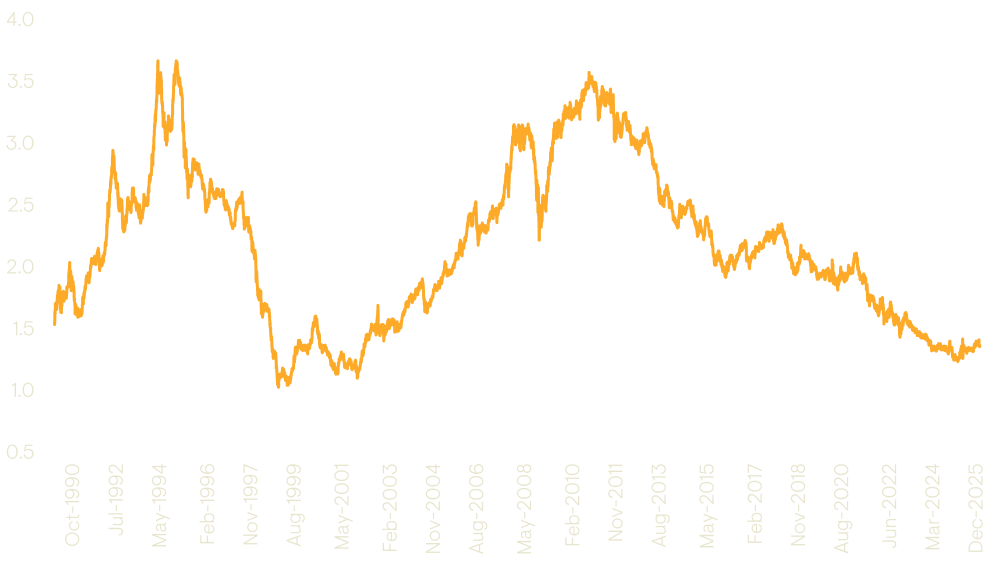
Source: Bloomberg. A rising line indicates outperformance of the EM index, December 2025.
The EM balance-sheet cycle
By ‘balance sheet’ we mean both fiscal and external balance sheets. The last boom in EM equity outperformance from 2001-2010 was not just driven by China’s WTO accession (finalised in 2001), the subsequent commodity supercycle (2001-2011) or a period of US dollar weakness with euro and yen strength (which in part supported EM currency strength). It was substantially driven by stabilisation following the balance sheet clean-up after the Asian crisis of the late 1990s. With deleveraging, downsizing, devaluation and – in the cases of Indonesia, South Korea, Thailand and Malaysia – default and restructuring, balance sheets were ready to re-leverage and underpin faster growth.
The EM fiscal balance-sheet cycle can be characterised as mid-stage. It is not as resilient as it was in the early 2000s, when strong growth and primary surpluses were pushing debt to GDP ratios down. On the other hand, the sharp increase in debt since 2020 has been driven by the one-off event of the short-lived 2020 recession, as well as a sharp rise in real rates, which is likely to trend lower as inflation falls. Indeed, for the large middle-income countries that make up the JPMorgan Government Bond Emerging Markets Index (and which are well represented in the MSCI Emerging Markets Index), primary balances are expected to rise to a level that will stabilise debt by the late 2020s (Figure 2). Interest costs as a share of government revenues are trending higher, but are still approximately what they were in the early 2000s.
Figure 2: Primary balances in EM economies expected to return to debt-stabilising levels by the late 2020s
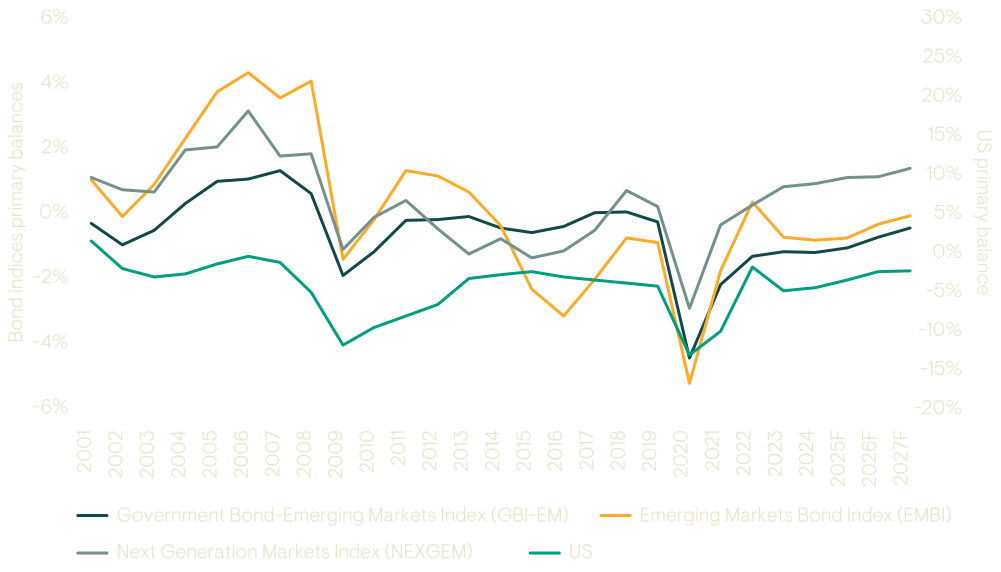
Source: IMF, Ninety One, July 2025.
As for external balances, the picture can be characterised as early cycle and relatively restrained for emerging markets as a whole, with a falling external stock of debt, moderate debt service costs relative to history, and current-account balances that remain positive.
On balance sheets, therefore, EMs are generally reassuringly ‘early to middle’ rather than at the end of the macro-financial cycle.
The commodity cycle
Commodities matter for EM importers and exporters. They both benefit in the early phase of a commodity cycle: exporters enjoy terms-of-trade gains, while importers profit from robust global demand. Later, high energy costs and over-extension bite, and importers and exporters slow together. Eventually, high prices and rising leverage put strain on EM importers. Global demand slows, commodity prices fall and EM exporters’ balance sheets weaken until a reset clears the system – after which the cycle starts again.
Where are we in the current commodity cycle? Global trade is not in a renewed surge: growth in goods flows is positive but subdued, not a synchronised expansion that characterises the start of a new cycle. Commodity prices, particularly for energy and bulk materials, have softened – oil supply exceeds demand, and broad indices are forecast to fall – while the brief rallies in industrial metals such as copper appear driven more by supply disruptions than robust global demand. This seems a market in a mature or steady state, without a significant trend.
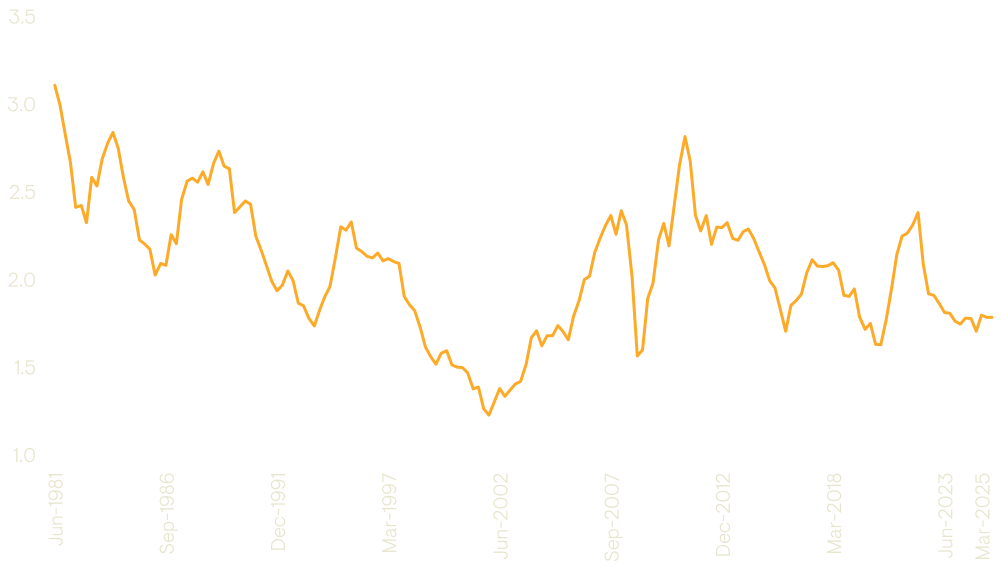
Yet, looked at in the long term, a different picture emerges. Real commodity prices peaked in 2010 and have since generally trended lower since (Figure 3). 2025 looks like the tail-end of a downcycle. One could make the case for a multi-year upswing beginning from here or later this decade, especially given the global capital-expenditure investment cycle now underway.
From an investment-behaviour perspective, the case for being early in the cycle is even stronger. Capital deployment among natural-resources companies is currently conservative and disciplined, with them requiring a higher hurdle rate before expanding capacity. This is different to behaviour in a late-cycle context, which typically sees less disciplined capital expenditure and higher capital raising.
On balance, taking a longer-term view, the commodities cycle likely indicates that EMs are early stage.
Figure 3: Real commodity prices are trending down
CRB Commodity Index/Consumer Price Index
Source: Bloomberg, July 2025.
The US dollar cycle
Finally, where are we in the US dollar cycle? In our view, we are at the end of a long US-dollar upcycle that began in 2011, the third such upcycle since 1970. Dollar cycles are long, typically lasting around 7-12 years. This one is now in its 14th year, sustained by economic outperformance and higher yields, cross-border asset flows, repeated global shocks that reinforced safe-haven demand, and the baseline geopolitical and geo-economic centrality of the US. The result has been a structurally strong and overvalued US dollar, along with overvalued US assets, which markets know fondly as ‘US exceptionalism’.
Now, several of the structural forces that underpin US dollar strength are turning. Interest-rate differentials are normalising following a period of secular stagnation and weak growth drivers in Europe and Japan. The US twin deficits are widening again, echoing past US dollar peaks in 1985 and 2002, while tariffs risk slowing growth and fiscal expansion risks undermining confidence in the US policy mix.
Meanwhile, investors are heavily overweight US assets, setting the stage for capital to rotate abroad as other regions regain competitiveness. History shows the US dollar only reverses when geopolitics and trade dynamics, rate differentials, investment flows and foreign-exchange policy all shift together. In our view, markets are waiting for the foreign-exchange policy shift, something akin to the 1985 Plaza Accord, the 1971 Nixon Gold Shock, or the rise of the euro in the early 2000s. Many candidates could play that role. From a US dollar perspective, therefore, 2026 is very much ‘early cycle’ for emerging markets.
An encouraging backdrop
To sum up: on balance sheets, EMs are early to mid-cycle, with manageable external positions and mid-stage fiscal health; debt is higher than in the early 2000s but will largely stabilise as real rates ease. Commodities are early cycle, marked by subdued global trade and easing prices in the context of rational price behaviour by commodities firms. In contrast, the US dollar cycle appears late-stage, with overvaluation and fading US exceptionalism suggesting the next turn could favour EM currencies and assets.
Taken together, the picture is reasonably constructive for emerging markets from a structural macro-financial view and supportive of relative strength ahead.
